


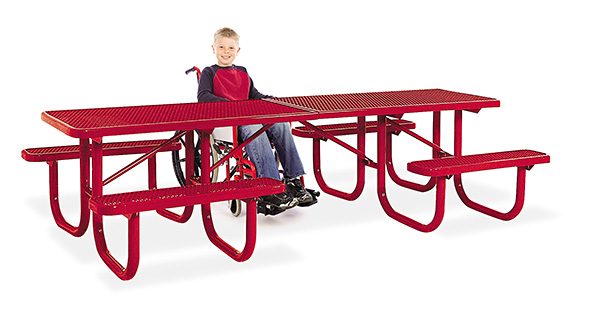
 ADA picnic tables with wheelchair access in the center
How accessible are your parks or facilities for providing ADA picnic tables, grills or even bleachers?
Because here is an important statistic. The National Park Service estimates that 1 in 5 Americans has a disability. (One reason why the Americans with Disabilities Act was signed into law in 1990.)
For that reason, back in 2012, the National Park Service created a group, the Accessibility Task Force, to study and find ways to ensure that parks are accessible to people with disabilities.
That task force created a strategic plan called "All In! Accessibility in the National Park Service - 2015-2020."
The group came up with three main goals:
- Create a welcome environment for visitors with disabilities
- Make sure that new facilities and programs were created with accessibility in mind
- Upgrade existing facilities to provide better access
When you think about the implications, visiting a park can be a rewarding experience for someone who is confined to a wheelchair at home or the visually impaired.
As we know, spending time outdoors can have incredible effects on the human physiology and psychology.
Studies have shown that "forest bathing" (as the Japanese call it) has a positive impact on blood pressure, breathing, immune systems, circulation, energy, bone strength, etc.
The sun and trees have been proven to elevate levels of serotonin that affects moods and attitude.
People with disabilities should not be deprived of the benefits of the outdoors and our national, state and local parks.
ADA picnic tables and other changes create better access
For that reason, many parks have become involved in ambitious programs to make their parks more accessible. Plus the federal government has committed millions of dollars to help parks create better access for all.
Some of those changes include:
- Widening trails for wheelchairs
- Paving over trails and creating smoother pathways for wheelchairs
- Providing ramps into all structures
- Removing or changing the elevation of some guardrails so the views are visible to people in wheelchairs
- Providing signage and historical markers in braille so the blind or visually impaired can learn about park amenities or history
- Making historical buildings easier to access
- Providing ADA picnic tables with a section of the table open for wheelchair access
- Adding ADA drinking fountains
- Making campfire areas more accessible and adding ADA-compliant charcoal grills
- For parks with ball fields, custom ADA bleachers can be installed with wheelchair ramps and seating. (Which would include companion seating as well).
Think about the importance of providing outdoor site furnishings for people with disabilities.
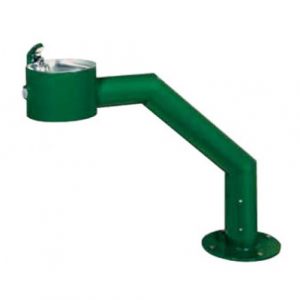 ADA drinking fountains that can be reached by a park visitor in a wheelchair
Imagine the frustration at a large family gathering for a picnic when for example, an elderly relative in a wheelchair can't sit comfortably with the rest of the family.
With an ADA picnic table featuring a cutout for wheelchair access or an extended table with clearance underneath, that person can become fully engaged with everyone else.
If they want, with a lower-profile ADA charcoal grill, they can even get involved in the cooking.
In case you haven't noticed, it's hot out there. That means people must stay more hydrated than ever. And that would include the handicapped as well.
There are ADA drinking fountains on the market with lower and tilted pedestals that make it easy for a person in a wheelchair to quench their thirst, just like everybody else at the park.
ADA accessibility also makes economic sense
Sure, there's an expense involved with retrofitting parks and facilities to make them more ADA-compliant.
Ramps cost money to build. Renovating long trails is time-consuming.
But the National Park Service also suggests that facilities consider the economic potential of providing better access for people with disabilities.
As we said, it is estimated that 20% of Americans have disabilities. The NPS also conducted some research and estimated worldwide, about 10% of travelers have disabilities.
If you think of the 300 million people who visit our national parks every year including foreign visitors, that means an estimated 10% of them could be handicapped.
Thirty-million park visitors represents lots of buying power.
If you provide access for those people and their families, think about all the money they would spend on entrance fees, gift shops, and concession stands.
Outside of the park, think about the positive impact of more dollars flowing into hotels, restaurants, stores and gas stations.
Here's another economic benefit to consider.
Americans are getting older. Many Baby Boomers have retired or are getting close to retirement. (That's another reason why we have record numbers at our national parks and record sales of recreational vehicles. These people are hitting the road.)
The US Census predicts there will be 83.7 million Americans over 65 in 2050. That's almost double the huge number of seniors now.
If these people like to visit parks, which the numbers indicate they do, think about how retirees can be encouraged to visit parks if the facilities are handicap-friendly.
The potential revenue is incredible.
Add more ADA picnic tables at concessions stands.
If your park or facility is known to be ADA-friendly, more people will visit there and pay for those ADA picnic tables many times over.
Add more ramps for exhibits. Include more braille and hands-on exhibits for the visually impaired.
All of these people will spend money on the experience.
The National Park Service estimates that the average visitor spends $129 per day at a park and gateway communities surrounding the park. Multiple that by 28 million visitors and you are looking at $3.6 billion in annual revenue.
That's a whole lot of revenue.
This money-making formula applies not just on the national level, but can be applied to state and local parks.
And not just parks. The revenue potential is also there for water parks, theme parks, sports facilities, etc.
Providing ADA picnic tables, grills, drinking fountains, trails, ramps, etc. is not only the right thing to do as far as providing equal access to all Americans, but it makes economic sense as well.