


 Commercial recycling receptacles are prerequisite to earn LEED credit
Anybody in construction knows that LEED certification is a very complicated process. But when it comes to one requirement for recycling, it may be one of the easiest tasks to accomplish. All it takes is some space and some commercial recycling receptacles.
LEED stands for Leadership in Energy and Environmental Design. It is a coveted designation awarded by an organization called the U.S. Green Building Council. The group gives a building certification based on qualifying credits earned for practices that are eco-friendly and energy efficient. The premise behind the award is simple - to encourage the building of structures that have less of an impact on the environment than a standard construction project.
There are different certification levels depending on the requirements you meet in the application. Those levels are Certified (40-49 points), Silver (50-59), Gold (60-79) and Platinum (80-plus).
Achieving the certification is a great achievement. With the right energy efficiency practices this is something that will save money for the building owners over the long run. Consideration is also given for reducing impact on the planet's resources by using materials that were recycled, existing or shipped from a short distance away.
Earning basic certification shows the building owners are also solid, eco-minded citizen as well. A platinum designation is monumental.
Any designation is also a great marketing opportunity to show tenants, workers and the community that this building has spent considerable time and expense to contribute to sustaining the environment.
However, as you can imagine, to be precise and to be sure that a building is actually environmentally-friendly, the requirements can be very strict.
There are very detailed specifications for each of their categories - Innovation and Design, Location and Linkages, Sustainable Sites, Water Efficiency, Energy and Atmosphere, Materials and Resources, Indoor Environmental Quality, Awareness and Education.
There are credits and then there are initial requirements that must be met to earn credits. When it comes to Materials and Resources, the Storage and Collection of Recyclables is a prerequisite.
The impact could be significant. You can imagine the amount of trash a large commercial building can generate, either from office employees, retail workers or customers. A large percentage of that garbage would be recyclable, such as plastic water bottles or paper bags.
Why throw it away? Simply provide commercial recycling receptacles in a designated area. If you are going to build an environmentally-friendly building, you are also going to want to show that you engage in environmentally-smart practices as well.
Add commercial recycling receptacles and a designated space
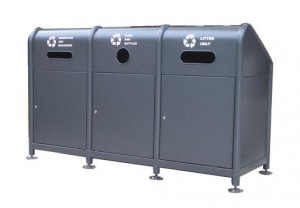 Commercial recycling receptacle
According to LEED experts, this can be done with just a few steps.
First, a builder must designate an area where the commercial recycling receptacles will be located. There are no actual square footage requirements. You only need to set aside just one space.
The recommended size of the minimum recycling area for collections depends on the size of the commercial building.
For 0-5,000 sf = 82 sf
5,001 - 15,000 = 125 sf
15,001 - 50,000 = 175 sf
50,001 - 100,000 = 225 sf
100,001 - 200,000 = 275 sf
More than 200,001 = 500 sf
After that location is established, then you can fill it with commercial recycling receptacles or commercial recycling bins. That's easy.
Finally, you need documentation. Simply provide a description of the space provided and information about accessibility to the recycling area, the anticipated volume and the pick-up schedule by haulers. Make sure the haulers are truly committed to recycling standards. Check to see if they offer commingled or separated recycling processes.
Be sure to note you provide collections for the FIVE major recyclable materials - plastic, cardboard, metal, glass and paper.
Also, let tenants know in the leasing agreements that there is a designated area for recyclables.
For any LEED certification, experts advise builders to work with architects who are experienced with the specifications or have access to the right information.
Sometimes life throws you an easy pitch. When it comes to meeting requirements for LEED recycling, by just setting aside an area and adding commercial recycling bins, you can accomplish an environmentally-friendly win with little effort.