


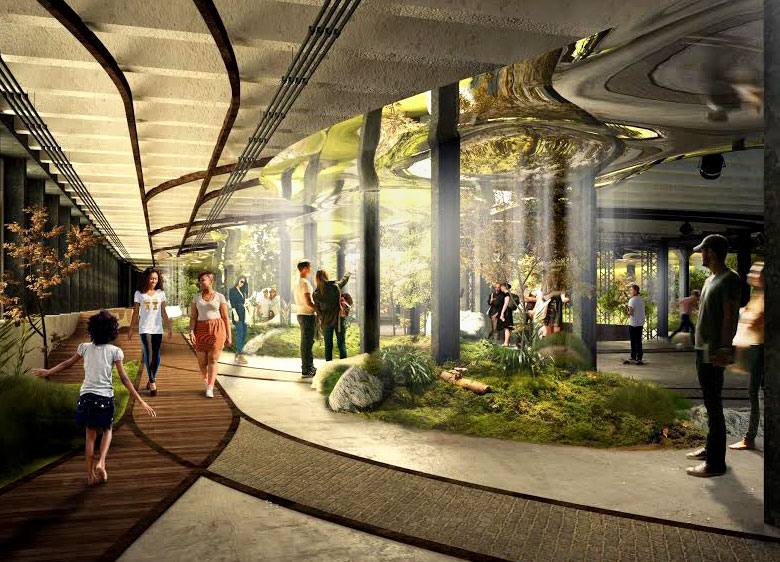
 Rendering of proposed Lowline underground park. Source: www.thelowline.or
There's a major transformation taking place around the world and like any major change, there are rippling effects that go along with it.
That's why a project currently in development in New York City - the "Lowline underground park" could have major implications around the world. (Ironically, today is "Back to the Future Day" wherein the movie Marty McFly travels forward in time to save his children).
Because here's one major fact. The population in urban areas is going to double.
Millennials, those born between the 1980s to 2000, are moving to the cities. After living through the Great Recession, they realize that's where the jobs are. There are more opportunities and employment choices in metro areas.
Secondly, after growing up in the suburbs, this young generation also feel cities are where the action is - more nightlife, more attractions, and many more choices than offered by the local malls.
Third - millennials are not interested in driving. They spent their lives ferried around by their parents in mini-vans or watching their parents commute long distances to work. They're tired of traffic jams (who isn't) and prefer to walk or bike to work or take mass transit.
This trend is taking place worldwide as well.
According to the book, Resilient Sustainable Cities, the number of people in the US will increase by 30% by the year 2040. Globally, there will be an additional 3 billion people on the planet by 2050. Where are all these people going to live? In metro areas. Each month an additional 5 million people are expected to reside in cities around the globe.
The end result of this demand? Space in cities where space is already tight and expensive, is going to get even tighter.
So with all this activity going on, how are city officials ever going to find real estate for a park? While a park might not have as much financial value as a skyscraper, it certainly has incredible psychological value as a refuge from the steel boxes and concrete canyons.
The organizers of Lowline park have a solution. Build a park underground.
They even found a convenient spot - an old trolley terminal below Delancey Street in Manhattan that has been out of commission since 1948. The space is about the size of a football field. (You can see this tract of subterranean land across the tracks at the JMZ Subway Station on Essex Street.)
How Lowline underground park harnesses sunlight
Okay, so they have the space. It still has some of the cobblestone walkways and other architectural amenities from the terminal.
But it's tough to create a park without plants. Where are they going to get the sunlight?
The Lowline underground park team has a solution for that. One of the co-founders, James Ramsey, is a former NASA engineer. He has developed a system where sunlight is captured in a solar collector above ground and then pushed down a pipe to a distributor dish where it is spread around the area. Rather than diffuse the light, this system actually intensifies it.
Once there, it can be aimed at a variety of plants - ferns, moss, even pineapples.
Seems crazy? They are actually doing this now with a lab they built nearby to demonstrate the technology.
An underground park is not the conjuring of some science fiction writer. It's happening folks.
Think of the incredible implications. First of all, what a great attraction. Cities can build these parks right in the middle of town. Make them cool in appearance. However, there's no need to go overboard. You won't need roller coasters or haunted castles to attract people - all you need are a few park benches, picnic tables and an incredible array of plants.
Remember, for city dwellers who are confined to office buildings and apartments all day long, looking at a bunch of plants or flowers is a BIG attraction.
Use these underground parks to attract tourists. In addition to all those standard park features - plants, benches, picnic tables and playgrounds, why not add some unique sculptures or artwork? Because the park will be housed underground, it won't be exposed to extreme elements such as snow, wind or rain. There will be more flexibility with the type of artwork that can be installed underground.
How about during the summer? With all that asphalt and lack of wind, cities can be brutally hot from June to August. Here's a perfect solution. Build more underground parks, where the entire area is already in the shade.
Another benefit is exercise. A fitter populace means fewer people visiting the hospital and doctors and less of a strain on medical resources and spending. (Speaking of haunted houses, take a look at medical costs in any state. The size of health care expenditures are downright frightening. Taking a preventative approach can justify the costs of lots of underground parks).
Lowline named one of most interesting Kickstarter projects
The Lowline underground park started as a Kickstarter project by Ramsey with co-founder Dan Barasch and immediately raised enough money to start the project. In fact, Mashable named it as one of the most intriguing Kickstarter projects of the year.
This is not something that will be built overnight. The New York Metropolitan Transit Authority actually owns the property and officials said they are unable to allocate any funds. But the Lowline underground park organizers are working with the MTA and there is incredible support from local, state and national politicians to make this idea a reality. The projected opening is in 2020.
One more thing. Wonder why it's called the "Lowline?" You might have heard, there's another innovative project in NYC called the "Highline." It's a park that was created on an abandoned elevated rail line that runs through the city. The city took a tract of space that wasn't being used, and turned it into a heavily used park that is coveted by the public.
Sure, land in cities is scarce. That's why creative thinking is required to find park-like spaces for the public.
Think of all you can do with the Lowline underground park solar technology. You could literally build a park on top of a park and pipe in sunlight to the lower levels. Or, you can stick a park right in the middle of an apartment building (one skyscraper in NYC already plans to do this).
A measure of a city's success is not how many people you can pack into a limited piece of terra firma . It's how many public amenities such as parks you can provide to help people connect with nature in an environment dominated by metal, glass and cement.
The city, the state, the nation and in fact the world should get behind this project.
As all those billions of people flock to cities, buildings will get bigger and aboveground streets will get more crowded. Amenities such as the Lowline underground park are going to be a welcome oasis for them.
The Park Catalog is a major supplier of commercial grade outdoor furniture, both above ground and below ground.
Update: The Lowline Lab that showcased plans for the park and some of the technology has closed. The park now needs funding to become a reality. All city officials have to do is look at the popularity of the High Line park, which draws 5 million visitors annually, to see what an economic engine this could be for visitors, tourists, area businesses and developers (and increased tax revenue).