


 Demand is high for recycled plasti
When it comes to saving the planet and using products made with recyclables such as plastic picnic tables and plastic benches, there's good news and there's bad news.
First the good news. Chalk this one up to American ingenuity. Manufacturers in the past decade have become very, very adept at creating high-quality products using old milk jugs, soda bottles, bottle caps, plastic bags, etc.
Some of those products included plastic picnic tables, plastic benches, pipes and even spun plastic fibers to make clothing.
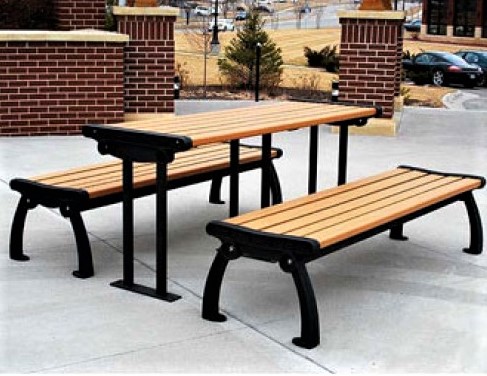 Plastic picnic tables made from recycled plastic scrap
Here's one of the ironic, positive outcomes of all this. Mother Nature has provided us with incredible raw materials such as cotton, wood and iron to manufacture products, The American Manufacturer has developed processes that reuses plastic and creates products with some attributes that make them just as attractive as items made with natural materials.
Take recycled plastic benches for example. One of the major challenges with recycled plastics is that not all plastics can be used for the same products. Some plastic products, such as milk jugs, provide a stronger plastic byproduct compared to say other plastics products, such as egg cartons or flexible container lids.
When making benches for parks or pipes for water lines, you need high-density polyethylene plastic classified as 02 HDPE.
To gather that waste, there is a complicated process of sorting that takes place at the recycling facilities and continues at the manufacturing plant. Not only does the plastic need to be sorted, but when it is shredded and melted, all the impurities, such as paper labels, need to be removed.
Not any easy task. But manufacturers have developed ways over the years to make this happen. This ensures that when those plastic planks are produced, they are 100% pure.
Some advantages of this reused plastic is that the material is incredibly resilient and can last for many years. The planks on plastic benches and plastic picnic tables won't crack or splinter like wood. In addition, since the material is so dense, mold can't get in. And sorry graffiti artists, but paint won't get in the substance as well. So any spray-painted works of art can be easily removed.
 Recycled plastic benc
Another advantage of this plastic is that it is very resistant to UV rays, which differs from wood, where the sun's rays can literally break down the fibers and initiate deterioration. If that wasn't enough, the plastic planks are somewhat flexible, so they can bend. When someone sits on them, they give a little and provide a bit of extra comfort.
Great. So here we have a product that does not use natural resources, does not generate carbon emissions and reduces the amount of waste in landfills. That's the ecological bullseye. That's what all those Earth Day celebrations are all about.
Here's the bad news. The demand for recycled plastic scrap is way outstripping the supply. The EPA reports that Americans only recycle 9% of the plastic they could recycle. Just 9%. That means there is a huge potential out there to reuse the other 91% of plastic waste that currently is filling up garbage cans, garbage trucks and expanding landfills.
Plastics make up almost 13% of municipal solid waste. Back in the 1960s, it used to be 1%. Thankfully, 28% of HDPE-classified bottles are recycled. But still, that's a whopping 72% left on the table, or in this case, the landfill.
This is frustrating because according to the American Chemistry Council, more than 80% of Americans have easy access to ways to recycle (at least in the home).
There's a huge potential for gathering recyclables outside the home. We're starting to see recycling receptacles in public areas such as parks and airports. The City of Cleveland Office of Sustainability recently added a bunch of recycling bins downtown near key locations such as the Rock and Roll Hall of Fame museum.
This effort generated 42 tons of recyclable waste! You can see, Americans are cognizant of the benefits of recycling and if you make it easy for them to recycle, they will.
What's amazing is that according to recent studies, the demand in the US for raw recycled plastic has risen nearly 6% every year. There are estimates that 3.4 billion pounds will be needed by 2016.
What a great problem to have! There is obviously a demand for raw recycled plastic. It's not as though all those efforts by millions of Americans every week sorting and placing their trash in recycling bins is going to waste (sorry for the pun).
Somebody actually wants that used plastic. Big time. They will be using that reusable material to make products such as plastic picnic tables and plastic benches.
It's a perfect cycle for sustaining the planet - make a product, use it, return it, grind it up, make another product, use it, return it, grind it up, etc.
But there is a major disconnect here. Most Americans probably don't know there is a big demand for more plastic scrap.
Perhaps more efforts should be made to educate them on this great solution for the planet. Maybe cities with recycling facilities and sustainability programs could display more products made with recycled plastic. When the public sits down at plastic picnic tables or plastic benches made with recycled materials, maybe they could see a plaque indicating this is a product created from their efforts to recycle all those used milk jugs. Add a message to recycle even more. Let them know there is a big demand for more of those milk jugs and water bottles (this will also lower the cost of items made with recycled plastic).
 How2Recycle graphi
One problem is that many Americans say they don't know what can and cannot be recycled. To address this problem, there are organizations such as How2Recycle which is working with national companies to put labels on their products which clearly outlines if and how this product can be recycled (see illustration).
Some of those eco-minded companies include Minute Maid juice, Clorox, McDonald's, Target, Best Buy, Kellogg's and many others.
The opportunity here to help the environment is enormous - you have businesses aligned with the environmental community on this particular issue, not something you see all the time.
Getting more Americans to recycle more plastic is going to result in more plastic products such as plastic picnic tables and plastic benches in our parks, bigger forests to walk in and smaller landfills that require less expansion.
Americans will face many challenges in the 21st Century, but here's one positive and simple eco-strategy we can all agree on. Recycle more of those plastic bottles and put them back into circulation as high-quality eco-friendly products.
Here's the EPA site on plastic recycling.