


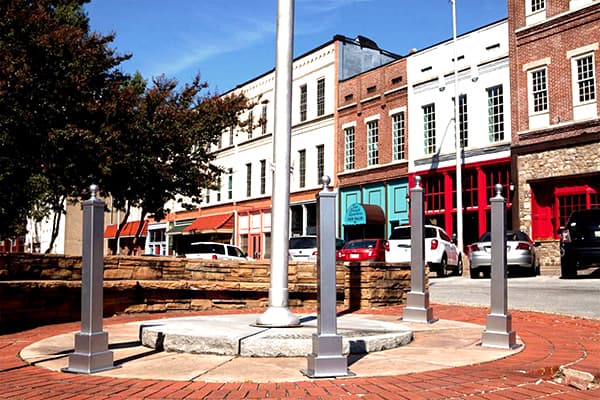
 Parking bollards in a downtown setting
People see them every day. Few probably know what they are. But these often overlooked traffic-controlling devices have an incredibly long history of stopping vehicles, steering pedestrians and saving lives. They are called bollards.
Parking bollards (also known as traffic control bollards) are basically those unassuming posts you see sticking out of the ground in various locations - on streets, on crosswalks, in front of stores, government offices, schools and other structures. They quietly direct people and drivers in the direction that planners want them to go...or not go.
Bollards come in all shapes and sizes. Most are pole-like and stand a few feet tall. Some are tall, like the ones you see in front of Best Buy. Some are squat like you might see in front of a courthouse. Others are thick in circumference, meant to stop a large truck, even a tank.
And while many people are not consciously aware of these traffic control devices, their purpose is extremely important - to protect humans, in a variety of ways.
For example, one of the favorite pastimes in Florida seems to be elderly people driving into stores, post offices or convenience stores. You name it. Almost once a month there is a photo of a car sitting in the middle aisle of a retail establishment next to the cereal and canned goods.
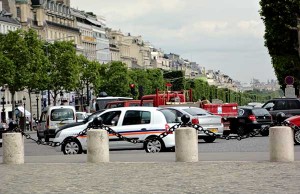 Concrete bollards with chain-link keep cars away from pedestrian areas
When parking bollards are placed strategically in front of a glass storefront or any store for that matter, they can prevent an out-of-control driver from parking that car where it is not meant to be.
Parking bollards keep cars away
At malls, you will see large sturdy bollards situated strategically near store entrances. This is because at one time it was a trend with burglars to smash their cars directly through the doors of major department stores and grab whatever they could grab.
Many government buildings are also shielded with bollards to thwart angry citizens or terrorists. There are several recorded instances where people with bad intent tried to drive into buildings but were stopped.
Those bollards can literally stop a truck laden with a load of harmful materials.
Many cities have added traffic control bollards to street corners or parking lot bollards to parking areas as thousands of pedestrians are killed every year by neglectful drivers.
Not all bollards are built like brick walls, so to speak. Some are made of plastic or rubber and just used to delineate pedestrian walkways or driver lanes. They are manufactured to be collapsible, portable and temporary.
However they are used, traffic control bollards are not something new. Whether you realize it or not, they have been a major part of the landscape for centuries.
The history of traffic control bollards
Bollards were first created in the 1700s when cannons were buried into the ground and used to moor ships near a wharf.
The name originated from the Old English term "bole" and is closely related to the Old Norse word "bolr."
As horse-drawn carriages became the more popular mode of transportation, bollards were installed near pedestrian areas to keep people from getting trampled. Wooden posts were used and reportedly the first documented presence of bollards was found next to the medieval Waltham Cross in Hertfordshire England in 1721.
Since that time, the use of bollards has been very clever. They are not only situated to direct vehicles but also to slow vehicles down by narrowing a passageway. Temporary parking lot bollards can be deployed to create an instant parking area for cars.
In some countries, people have apparently become bored with the basic bollard look and painted them in decorative colors or painted them to look like people.
If you have a walking mall or parking lot in a downtown area, that area is probably protected by bollards. The great thing about these devices is that they can be permanent, they can be portable or they can even be retractable. With retractable bollards, the device is raised when necessary and lowered into the ground to allow authorized vehicles to pass.
 Workmen appear to have "bollard" themselves into a fi
There is a famous photo circulating around the web of some workmen in England who are seen installing bollards with their work truck parked next to them on the sidewalk. The problem is, it appears that the workmen have painted themselves into the proverbial corner with no way out for their vehicle.
An ambitious citizen with a camera snapped a photo thinking they had a great shot of some hapless workmen putting themselves in a bind. He sent it off to various newspapers.
Fortunately for the workers, the bollards were removable, so the workers were never made the subject of an international joke. Although the photo still made a viral leap around the Internet.
Site managers for parks, shopping centers, schools, events or basically any activities involving humans and vehicles are smart to have plenty of bollards either installed permanently or portable in storage for use when necessary. People and cars don't always know where to go or go where they are supposed to go. And just a slight mishap or misdirection could cause major injuries.
Whatever their use, perhaps after this article, you may start to notice these little devices and the purpose they serve. But take them seriously. Whether you are walking or driving, traffic control bollards, parking bollards and parking lot bollards are placed where they are placed for a major reason - to keep you alive and safe.
Note: Bollards can be made from a variety of materials but for parking bollards, it is recommended to use either metal bollards or concrete bollards.
To see parking bollards offered by The Park Catalog, go here.