


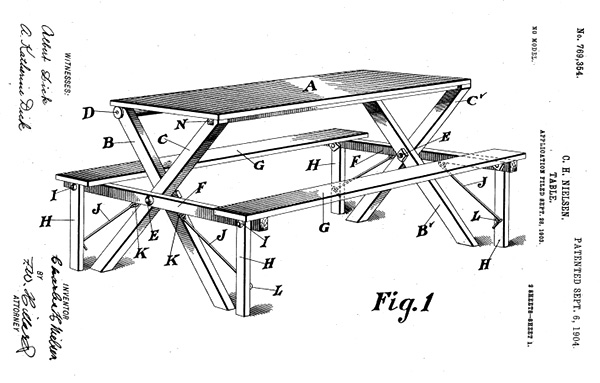
 The patent drawing for the first known picnic table submitted by Charles H. Nielsen
Back in 1903, a man named Charles H. Nielsen of Kreischerville, NY filed a patent for the design and production of simple picnic tables.
Little did he know that more than 100 years later, his simple yet brilliant invention would still be used today in thousands of locations around the world.
Ironically, back in those days, picnics were kind of random. People just drove up to a field or a park and parked wherever they wanted. At some locations, a roughly carved wooden plank would be placed on tree stumps dug into the ground.
Although according to Victorian-era standards, to experience the true feel of nature, a picnic was meant to be enjoyed sitting on a blanket on a field of grass. Tell that to the ants. Or the people who prefer to sit upright. Plus, sometimes the ground would be wet and mess up those fancy dresses and suits.
So there became a need for an outdoor table with a handy way to transport it.
Nielsen's first design was for a collapsible picnic table that could be transported by automobile.
In his application with the United State Patent Office he wrote: "My invention is an improvement in tables, the main object being to provide a table capable of being cheaply made, portable and equipped with seats, preferably on both sides and which can be folded up into a collapsed table for transportation purposes or for storage, and unfolded and set up quick when required for use with the use of tools or appliances other than those of the table itself."
Unlike most plain tables, his basic diagram showed the legs at an angle to support both the table top and the seat planks. It is said his inspiration came from the X-shaped design of a sawbuck-type table, which did not have the seat planks.
A cross-bar on both ends held up planks used for seats. The configuration creates a stable place to sit, with plenty of room for several people, that folds into a convenient flat surface. Certainly, much easier than lugging a table and chairs separately. And he purposefully kept it simple so that it could be affordable.
The design was a stroke of genius.
Picnic tables go from portable to permanent fixtures outdoors
Years later, especially with the advent of the first automobiles, more and more people took to getting away from cities, traveling to the outdoors and enjoying a picnic.
Like we said, at first picnickers would just pull up to any random spot in the woods or a field.
As more and more people frequented these areas for picnics, the managers of parks and private outdoor facilities began to realize it might be smart to start designating places to park. They then installed picnic tables at the site for convenience. These grew in popularity and were referred to as "picnic groves."
In the past, if your location offered a picnic table, that was a big deal.
In one old-timey advertisement, an amusement park promotes their fun activities for adults and children along with "Free Picnic Tables!"
Creating separate camping or picnic sites with a picnic table, a grill or a fire ring became a big hit with the public.
These areas were soon referred to as "roofless cabins." A way to get outside - enjoy the fresh air and sunshine and still enjoy some of the amenities of back home like the ubiquitous kitchen table.
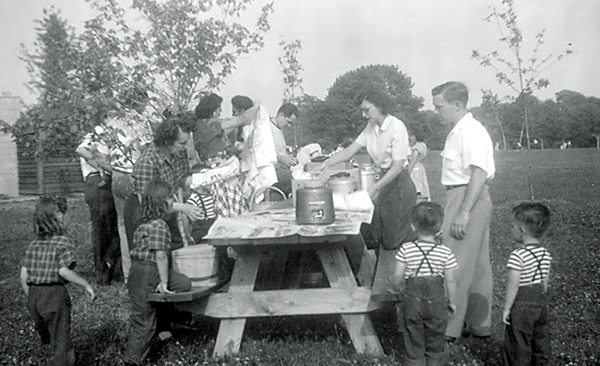 A vintage wooden picnic table
Picnic tables now come in a variety of styles, materials, coatings, and colors
Fast forward to today and there is an amazing variety of picnic tables on the market.
Many follow Nielsen's original design with the angled legs and the crossbar supporting the seat planks.
Others have a metal base with legs that are curved upward from the ground to support the seat and table. This walk-through design allows people to sit without requiring them to step over the cross-bar.
Some just have pedestal mounts which are basically poles driven into the ground to support the table top and seats.
Then there are the tremendous variety of materials:
Wood picnic tables - the old standby, these tables are now manufactured with pressure-treated wood planks so they last longer and delay warping or rotting. The Amish still make traditional wooden picnic tables for sale. Others now come with metal frames that are powder-coated or galvanized for support and ease of access.
Metal picnic tables - probably the most popular type of picnic table today. Many of these tables are ordered with a thick thermoplastic coating that has several advantages. For one, the coating prevents the metal was rusting or corroding. Secondly, that coating is super durable and easy to maintain. You never have to sand or repaint these tables. Third, the coating is impervious to all types of weather - snow, ice, rain and even harmful UV rays. They also are difficult to vandalize with spray paint. With perforated or expanded metal surface for the table top, liquids don't gather but pool right through. Plus, the holes in the top and planks keeps the tables cooler in the hot summer months. The fourth big advantage is that because these metal picnic tables are fabricated with steel, they come in a tremendous variety of styles and colors. Match your school colors. Add a laser-cut logo. Install an etched plaque for a memorial picnic table.
Concrete picnic tables - these tables are built to last (sometimes referred to as "cement picnic tables" also.) The tough surface is ideal for salt-air conditions near the ocean. In addition, these outdoor picnic tables must be moved with a forklift so owners don't have to worry about them being stolen. It's also possible to get concrete picnic tables with metal tops and seating.
Recycled plastic picnic tables - a modern version of wooden picnic tables, but these tables are manufactured with recycled HDPE #2 (high-density polyethylene) plastic scrap, which comes from hardy milk jugs and detergent containers. They resemble traditional wood picnic tables, but they don't splinter or deteriorate like wood. In fact, some recycled plastic picnic tables come with a 50-year warranty against termite infestation. The plastic planks also resist UV rays and are easy to maintain.
Aluminum picnic tables - speaking of portable picnic tables, these tables are super-lightweight and can be easily relocated anywhere around an outdoor setting.
Whatever your preference, there's no denying this fact: even in this era of amazing inventions such as the iPhone, one can appreciate the enduring power of C.H. Nielsen's first picnic table design, and its impact on civilization and families who just wanted to enjoy a day together in the great outdoors.